
MVP Strategy - Part 1. From idea to the first release.
“Seeing what people actually do with the product is much more reliable and useful than asking people what they would do.”
In software development, MVP is a core basis for experimentation strategy. Most digital projects start with hypotheses or assumptions of what their potential customers need. MVP is the tool, that allows understanding if the assumption was correct or not. Once the MVP is released, it gives a good basis for further experimentations going live. Based on the information gained from these experiments, we can rethink the whole business strategy or even discontinue the project. But first, let’s focus on MVP-related strategical steps till the moment of its first release.
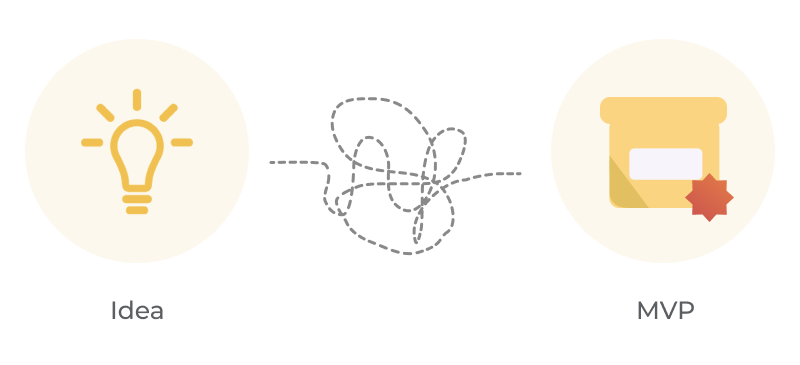
The boy wanted to play football during the breaks between classes in school. So one day he made a ball from crushed paper sheets, just forming the ball with his hands. It made a ton of fun and emotions for his classmates so he decided to bring a real one. The paper ball served as an MVP and worked great, while the real ball was very noisy (easily detectable by supervising staff), and in the end, the students were not careful enough and broke the window. A fun and entertaining activity ended up with parents required to visit the school, disciplinary sanctions, financial loss (for the window repair), and further limitations at home. In this case, MVP worked great, but the full-featured product failed because the environment was significantly under-estimated. Also, his due diligence lacked quality - many of us went through this “paper ball” experience and the boy potentially could have known it if he just asked. In order to develop an MVP that will work as expected, the correct strategy should be developed. In this group of articles, we are disclosing a detailed approach of strategy design for the MVP of a software project.
1. Understand the market
Everything starts from researching the environment in which you are about to deliver the new product. Analyze your competitors. Learn their products as thoroughly as possible to understand which features are the most viable for their/your customers.
2. Understand your potential customers
Your potential customers are part of the market. They ultimately define which product is good and which is not. So ideally, if you can learn from them by the means of online surveys, one-on-one interviews, analysis of the competitors, and product reviews, etc.
3. Define the features for MVP
Start by making a list of all the features that could potentially add value for your future customers. The next step is to sort this list by the value the feature brings to them. Once the list is sorted, the most viable features will be at the top. As the next step draw a line, separating features for the MVP from the features that will go with future versions of your product. Everything above the line is the feature list for your MVP. Based on what to draw this line is up to you: your decision could be driven by budget, timeline, or some other limitations.
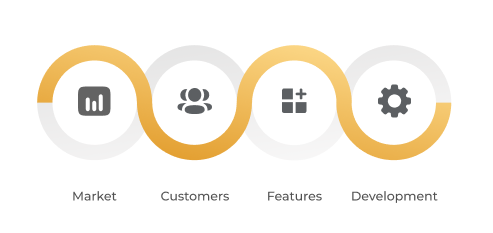
4. Develop the MVP
Now that you've assessed the strategic factors above and decided on the limited functionality you want for your MVP, it's time to turn your ideas into a development plan.It's vital to remember that the MVP stands for Minimum Viable Product. That is, it must enable your customers to accomplish a task or project in its entirety, as well as give a high-quality user experience. An application with a lot of half-built tools and functionalities isn't an MVP. It must be a functioning product that your customers can use.
You can decide on working with a software development company that would propose to develop any functionality for you, but keep in mind one thing: it does not make sense to develop something if this has been developed many times before. So before signing up for a $50k contract consider alternative solutions, such as MVP Rocket. According to our research, 80% of startups with a budget under $80k contain around 78% of the similar features, such as: authorization, chats, menu, shopping cart, payments, etc. So what we have managed to learn is to reuse the features we have developed previously. There is a special free online tool that allows estimating the MVP of any application in about 10 minutes - MVP Estimator.
5. Launch MVP
Every end is a new beginning. Once the product is developed, fully tested, the environment is set up properly, the codebase is ready to be deployed or submitted for review, then the project is ready for its first-ever release. At this moment the story of the first stage is completed: your app becomes available and real customers will be able to find it and try it. At this point, it’s time to start the marketing and sales activity. At the same time, you are no longer in the field of theory and anticipations. You are on the battlefield and the fact you started with MVP is your biggest advantage because you can see what users are actually doing with your product, learn from it, and improve constantly.
The MVP strategy applicable after the first release of the project is described in the second part of the MVP Strategy articles group: MVP Strategy - Part 2. MVP is live. Learn and improve (coming soon).
Let's start a project