
How to do market research for the software startup?
Like any other business, a software startup requires market research to determine whether there is a viable market for its product and to assess the competition. This research should include an analysis of customer needs and preferences, as well as an evaluation of the potential market size. The results from this research will help you determine the best way to reach your target customers and how much money you can expect to make from sales.
What is market research in a software startup?
Market research and analysis is the process of collecting information about consumers and the market in which they live. It helps businesses understand what products or services people want, how much they are willing to pay for them, and where they would like to purchase them. Market research can also provide insights into customer behavior and trends.
There are two main types of market research: Primary and Secondary.
Firsthand information that you gather yourself through interviews, surveys, focus groups, and observations.
A piece of information that has already been collected by someone else, such as government data or industry reports.
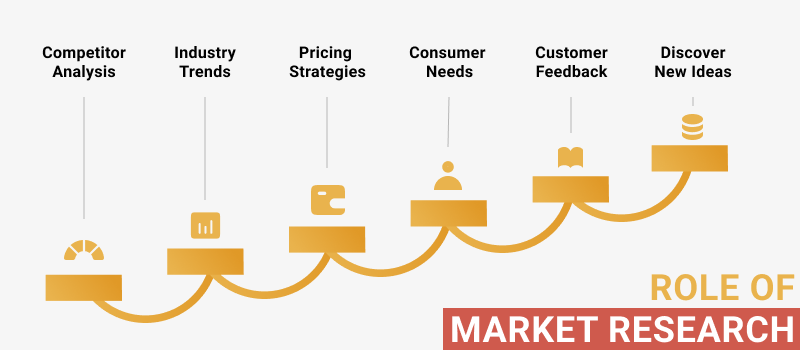
Purpose of market research?
Here are a few main purposes of market research for software startups:
Before you can start attracting investors, you need to show them that there is a market for your product and that people are actually willing to pay for it. The ultimate way to do this is by conducting market research and presenting the results in a professional and convincing manner.
Ideas are the first step of any startup journey. If you don't have a good idea, your software startup will likely fail before it even starts. That's why it's essential to spend some time on market analysis for researching different ideas and then selecting the one that has the best chance of success.
After you have a good idea, the next step is to validate it through market research. This involves testing your hypotheses with real consumers and gathering feedback from them. Market research will help you determine whether people actually want what you're offering and whether they are willing to pay for it.
Analyze industry trends
In order to achieve success with your software startup, it's important to stay up-to-date with the latest industry trends. This way, you can ensure that your product is relevant and in demand. Market research can help you identify these trends so that you can adjust your business strategy accordingly.
Especially in the software industry, understanding the industry trends leads to a good product and a better marketing plan.
The trend is always your friend; if you are moving against the trend, e.g., in the age of Artificial Intelligence, you are creating a product that needs a lot of manual work or data inputs, nobody gonna purchase it.
Compare competitors
In order to be on top of the market, you need to understand your competition. Who are they? What are they offering? What are their strengths and weaknesses? How can you differentiate yourself from them? Market research and trial can help you answer all of these questions so that you can develop a sound business strategy.
Here are a few ways to compare competitors:
Talking about a software startup, in this day and age, every company has a website. (That tells a lot about the company). Spend some time looking at their already built website and try to understand their business model. What kind of products or services do they offer? How do they market themselves?
If a company has a blog, it's a good way to stay up-to-date with the latest news and developments. Subscribe to their blog and read their posts on a regular basis. This will give you a nice idea of their thoughts and opinions on the industry, as well as their overall tone and approach.
Social media is a tremendous way to stay up-to-date with a company's latest news and developments. Most companies are active on at least one social media platform, such as Twitter, Facebook, or LinkedIn. Follow them on social media and pay attention to the kind of content they share, as well as the overall tone of their posts.
If a company is willing to share its marketing materials, such as brochures or presentations, it can be a goldmine of information. Pay attention to the terminology they use, their target audience, and the overall tone of the materials. This will give you a better and clear idea of their marketing strategy and how they position themselves in the market, and how you can do the same.
Define the features for the MVP
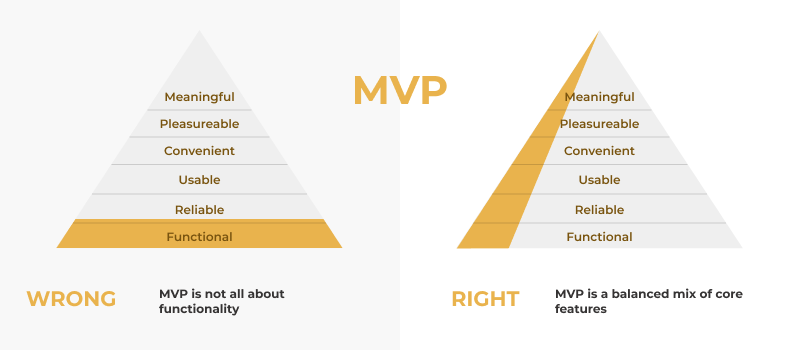
One of the best approaches for software startups is starting with MVP - Minimum Viable Product. The main idea of such an approach is to provide your potential customers with a minimal set of features that will allow assessing the future perspectives of the project.
Defining the features for the MVP is very important. The first step is to understand the customer's problem and then think about how your product can solve that problem. After that, you need to prioritize the features of your product. Not every feature needs to be included in the MVP. The goal is to create a product that is good enough to solve the problem at hand while also being affordable and feasible to build.
Tools for market research
The market is filled up with different kinds of tools that you can use to do excellent market research, but here are some with the most value.
SpyFu is a great tool for competitor research. It allows you to see how your rivals are ranking for keywords, as well as the ads they're running. As soon as you land on the homepage, you are asked to type the competitor's URL. After that, you can see all the keywords they are ranking for, as well as the ads they are running.
Think With Google is a significant resource for understanding consumer behavior. It's packed with data and insights on how people search and shop online. You can use the data to understand what people are searching for, as well as the trends in search behavior. This can be very beneficial when it comes to developing your marketing strategy. Like other services of Google, this one also offers a lot of useful information that can be really helpful for marketing purposes.
Statista is a great resource for data and statistics. It has data on just about everything, from demographics to consumer behavior. This can be very beneficial when it comes to understanding your target market and how to reach them. Statista has been a credible source of useful insights and data for years; you can surely use it for market research.
BuzzSumo is a great tool for content research. It allows you to see the most popular content in your industry, as well as who is sharing it. This can be very effective when it comes to developing your content strategy. You can use BuzzSumo to find the most popular content in your industry and then develop a similar piece of content that is tailored to your audience.
Google Trends is a great tool for understanding search behavior. It enables you to see how often a particular keyword is being searched for and the trends in search behavior. This can be very relevant when it comes to developing your marketing strategy. You can use Google Trends to understand what people are searching for and then develop a marketing campaign that is tailored to those keywords.
Qualtrics is an excellent tool for conducting surveys. It allows you to create surveys, distribute them, and then collect and analyze the data. This can be very beneficial when it comes to understanding your target market and their needs. Qualtrics makes it easy to conduct surveys and then analyze the data to get insights that can be used to develop your marketing strategy.
SurveyMonkey is another great tool for conducting surveys. It allows you to create surveys, distribute them, and then collect and analyze the data. This tool makes it easy to conduct surveys and then analyze the data beneficial for your marketing strategy.
Make My Persona is a great tool for creating buyer personas. It allows you to create a persona by answering a series of questions. Make My Persona makes it easy to create a persona that can be used to develop your marketing strategy.
Tableau is a very powerful tool for data visualization. It allows you to take data and turn it into visually appealing charts and graphs. Tableau makes it easy to take data and turn it into insights that can help you understand the market better. The best thing about Tableau is you don't need any coding knowledge to get started with Tableau.
These are some of the best tools that you can use for market research. With these tools, you will surely be able to gather the necessary data and insights that will help you develop an effective and efficient marketing strategy.
Let's start a project