
MVP approach to inspire your startup idea - Salesforce success story
About Salesforce. Salesforce nowadays.
It's no secret that Software-as-a-service or simply SaaS continues to be one of the tech innovations in the software product development space. It utilizes cloud computing to modernize business operations and connect customers anytime,
anywhere, and on any device. In the CRM software category, Salesforce turned out to be the most successful SaaS company today. Salesforce was founded in 1999 with a clear vision to become "A World-Class Internet Company for Sales Force
Automation". Salesforce combines everything a business needs to grow its customer base and business, including marketing, sales, commerce, and services, into an all-in-one platform.
Salesforce offering a cloud-based model taking advantage of powerful technologies such as mobile, social, blockchain, voices, and artificial intelligence was the critical differentiator ahead competition. Customer-focused solutions powered
by digital transformation, acquisitions of competitors, and new product launches accelerated their business expansion. Some of the significant milestones in Salesforce's product/software development include AppExchange (2005), Service Cloud (2009), and Safety Cloud (2022). Salesforce accelerated business growth by acquiring wireless tech startup company Sendia,
marketing cloud (ExactTarget), business intelligence platform (Tableau), and social media monitoring (Radian6). In 2012 Salesforce was ranked by Gartner as #1 in CRM and had maintained the position for nine consecutive years. Salesforce
today holds a 20% market share at $17 billion and is being used by over 150,000 business customers like Amazon, Puma, and American express.
This knowledge base will narrate Salesforce's success story to inspire your startup idea using a minimum viable product (MVP) approach.
How did it all start? Salesforce MVP
From the beginning, Salesforce's main agenda was to change the world through technology innovation to connect businesses and their customers. Salesforce's founders, led by Marc Benioff, began working on the first version of CRM fueled by an MVP idea to develop a software product available to people and businesses 24/7 over the cloud. Salesforce was the first E-commerce company to introduce a cloud-based software solution. On the contrary, tech giant companies vehemently opposed the idea because they believed in delivering on-premise software products. Today, startups and big tech companies are belatedly building cloud-based software, trying to catch on to the movement that Salesforce initiated. Driven by a clear vision of V2MOM (Vision, Values, Methods, Obstacles, and Measures), Salesforce as a startup planned a product launch with the grand debut of "No Software Installation" in 2000.

Salesforce introduced the first version of the CRM platform with minimum viable features necessary for the business to run. Salesforce started the first CRM software that connected businesses to manage all customer interactions in one platform around sales, marketing, and service. The V2MOM remains at the core of how Salesforce operates and runs its business and ultimate guidance in its decision-making process. And the idea of focusing team efforts, technology, and resources to launch a minimum viable product is being used by most startups today as they build, work to improve, customize, and launch new features in phases at scale.
What was the market when Salesforce was still an MVP?
According to a report by Gartner, The CRM services market share grew by 28% from 1999 to 2000, reaching nearly $20 billion worldwide. By 2001, Siebel Systems Inc. was the largest vendor with a 28.5% CRM market share followed by SAP AG with 10.9%. Like any startup, after successfully launching its MVP product into the market, the next phase is scale. In April 2001, Salesforce announced global expansion by opening businesses in Dublin and Tokyo and elected Marc Benioff as their CEO and Chairman.

In 2002, Salesforce launched an aggressive marketing strategy around their CRM product. Benioff and his team believed in their vision and focused on delivering a better on-premise software product, easy to set up and accessible 24/7. The move disrupted the entire CRM business posing challenges to competitors, which paved the way for Salesforce into the market.
How did the MVP work and why did the MVP succeed?
Salesforce MVP’s strategy worked because they had a clear vision and developed a cloud-based software product with personalization that people loved. The disruptive cloud product was entirely new for the consumers but aligned to business needs around sales, marketing, and service. The CRM software also offered a value proposition to the salespeople as 'better CRM’. Salesforce cloud distribution channels were powerful and went viral, and most tech companies joined the part as the idea was revenue-generating. Salesforce introduced a unique pricing model (pay-per-user) unlike expensive offers by competitors like Siebel and SAP was a key differentiator in the CRM market. Furthermore, the CRM software as a service was available to be tried for free so customers could match their exact business needs before making subscription commitments. Innovation of new solutions and products was another success factor for Salesforce as a startup. They built the AppExchange allowing developers from third-party companies to create their applications and sell them to other Salesforce users. Strategic acquisitions of competitors within or to supplement their CRM solution was vital for the success of Salesforce MVP. They acquired Slack for $27.7billion in 2020 which became their new interface for customer 360.
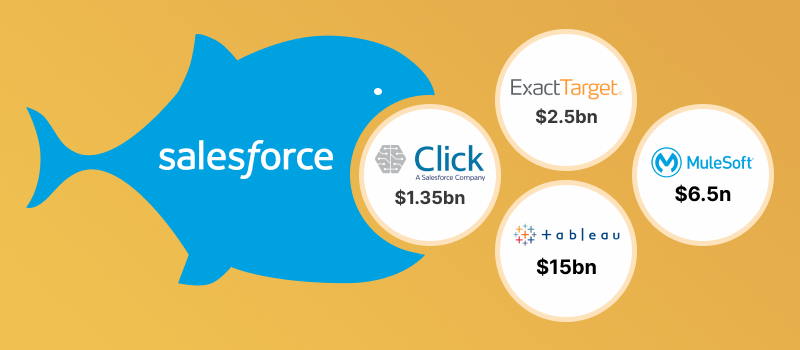
New product launches and software updates and features were equally crucial to Salesforce product development. Major product launches/features included the Service cloud (2009), the unique Lightning experience (2015), and Einstein as the first artificial intelligence for CRM (2017).
Why is Salesforce so successful now?
Salesforce today is the best-known CRM in the world used by fortune 500 companies and has a 23.8% market share with the potential to reach $1 trillion in market cap by 2035. You may wonder what makes Salesforce successful today and possibly in many years to come? First is Salesforce's core commitment to providing a solution that enables partnership growth and customer success above everybody else. MVP approach to software product development from an innovative product with minimum features that solves customer products. Then build on the custom, flexible, accessible products with cutting-edge technology as you grow, putting you ahead of the competition. Salesforce as a SaaS platform will by no doubt continue to be the number #1 CRM application that meets consumer demands and offers an excellent customer experience. Thanks to their all-in-one platform that's fast, simple, and right to use as per your business need in sales, marketing, and service.
Let's start a project