
How to raise funding for startup?
When starting a new business, raising funds is often a critical step. There are a variety of ways to go about this, and the right approach depends on your business and its needs. In this post, we'll discuss some of the most common ways to raise funding for a startup, as well as the pros and cons of each option. We'll also provide tips on how to make the process as smooth as possible. So whether you're just starting out or you're looking for additional funding, read on for helpful advice.

Get prepared
Getting prepared is the 1st step when you are raising funds for a startup, following are a few steps for you to get fully prepared for it.
Develop your mindset
Developing the right mindset is critical when you're seeking funding for a startup. If you don't believe in your business or yourself, it will be very difficult to convince others to invest in your venture. So take some time to develop a positive attitude and think about all the reasons why your business is worth investing in.
Research the market
You can't just walk into a room full of potential investors and start pitching your business idea without knowing anything about the market. Before approaching anyone for funding, it's important to do your homework and research the industry you're entering. This will help you better understand the needs of your target market and what investors are looking for in a business venture.
Create a business plan
A business plan is a document that outlines your business goals, strategies, and how you plan on achieving them. This is an important tool to have when seeking funding for your startup as it shows potential investors that you have a well-thought-out plan for your business. If you don't have a business plan, there are many templates and resources available at MVP Rocket knowledge base that can help you get started.
Learn How To Pitch
Pitching your business idea is one of the most important aspects of raising funds for a startup. You need to be able to sell your idea in a clear and concise way that will make investors want to invest in your business. There are a number of resources available online that can teach you how to craft a great pitch, so be sure to do your research before approaching potential investors.
Most widespread options for raising funding:
Once you are done with all these steps, it's time to look for possible options; here, we have stated a few.
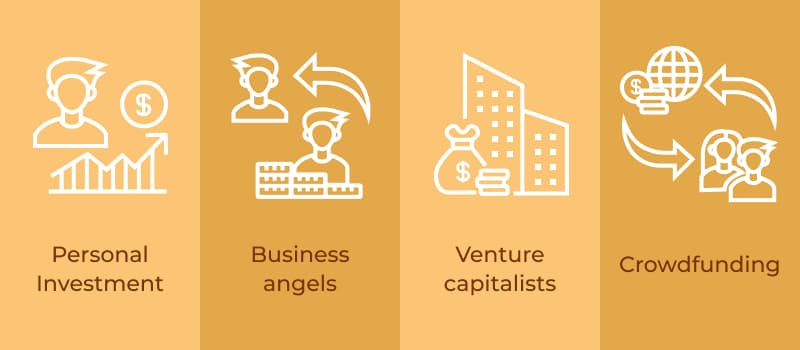
1. Personal Investment
This is the most common form of funding for startups as it doesn't require any external sources. Personal investment can come from your own savings, loans from family and friends, or credit cards.
The main advantage of this option is that you don't have to give up any equity in your company. However, the downside is that you may need to put up personal assets as collateral, and there is always the risk that you could lose everything if your business fails.
2. Business angels
Business angels are another famous option when it comes to fundraising for startups. An angel investor is usually a wealthy individual who is looking to invest in promising businesses. They typically provide both financial and mentorship support to help the company grow.
The advantage of working with angel investors is that they often have extensive experience and networks that can be helpful to your business. However, the downside is that you will likely give up a larger portion of the equity in your company.
3. Venture capitalists
Venture capitalists are usually firms that invest in high-growth businesses. They typically provide a large amount of funding in exchange for a significant amount of equity.
The advantage of working with venture capitalists is that they can help your business scale quickly. However, the downside is that they will have a lot of control over your company and may push you to take risks that you're not comfortable with.
4. Crowdfunding
Crowdfunding is a relatively new way of raising funds for startups. It involves using the internet to solicit small investments from a large number of people. The advantage of crowdfunding is that it's a great way to get your business off the ground without giving up equity.
However, the downside is that you may not be able to raise as much money as you would with other methods.
There are a ton of websites and organizations that offer to fund for startups. Here are a few of the most popular ones:
- 1.
Y Combinator
Y combinator is a Silicon Valley-based startup accelerator that provides funding and mentorship to early-stage businesses.
- 2.
Techstars
Techstars is a global network of accelerators that helps startups grow their businesses through mentorship and access to resources.
- 3.
500 Startups
500 Startups is a venture capital firm that invests in early-stage businesses.
- 4.
AngelList
AngelList is a website that connects startups with angel investors and venture capitalists.
- 5.
Kickstarter
Kickstarter is a crowdfunding platform that allows startups to raise money by soliciting small investments from a large number of people.
Now that you know how to raise funds for a startup, it's time to get started on your business plan! Remember, a great pitch is essential to securing funding, so be sure to put in the work and craft a compelling argument for why investors should invest in your company.
Let's start a project